
|
|
Journal Issue No. 5 - September 2005 |
|
|
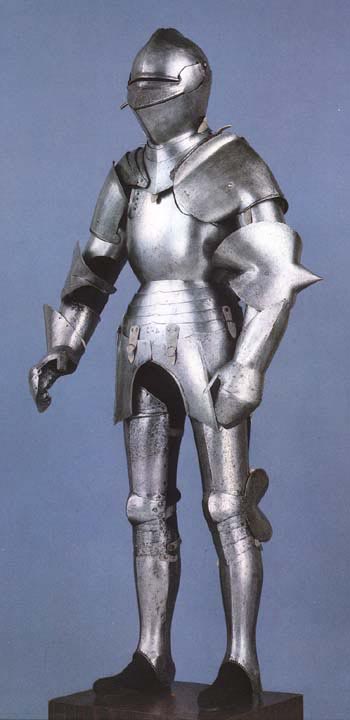
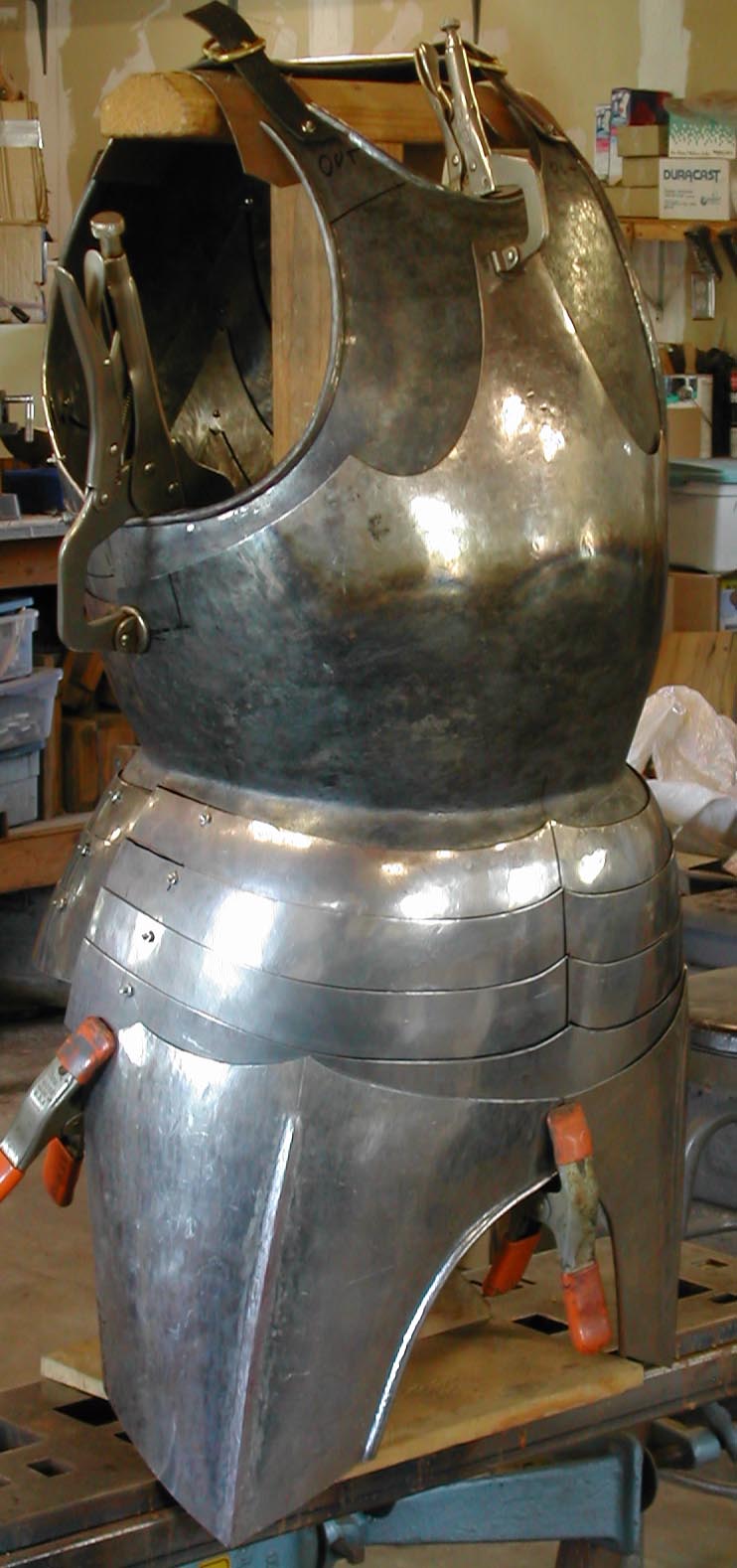
What's in a name? A Tale of Two Armours Following the lead of the Royal Armouries Museum in the UK with whom they are affiliated, the Frazier Historical Arms Museum in Louisville Kentucky has commissioned two suits of reproduction armour to be used in their interpretive program. When the suits are delivered, the Frazier will be one of two museums in the US to sponsor fully armoured demos of sword fighting and armouring the knight in their interpretive programs. Jeff Hedgecock of Historic Enterprises has been awarded the commission for the two harnesses, and in this interview he tells us a bit more about the armours themselves and the process involved in their manufacture. Two full harnesses of armour- that's quite
a commission! Can you tell us a bit more about how it came about? Do you know who else was on the list? So tell us about the armours you are building.
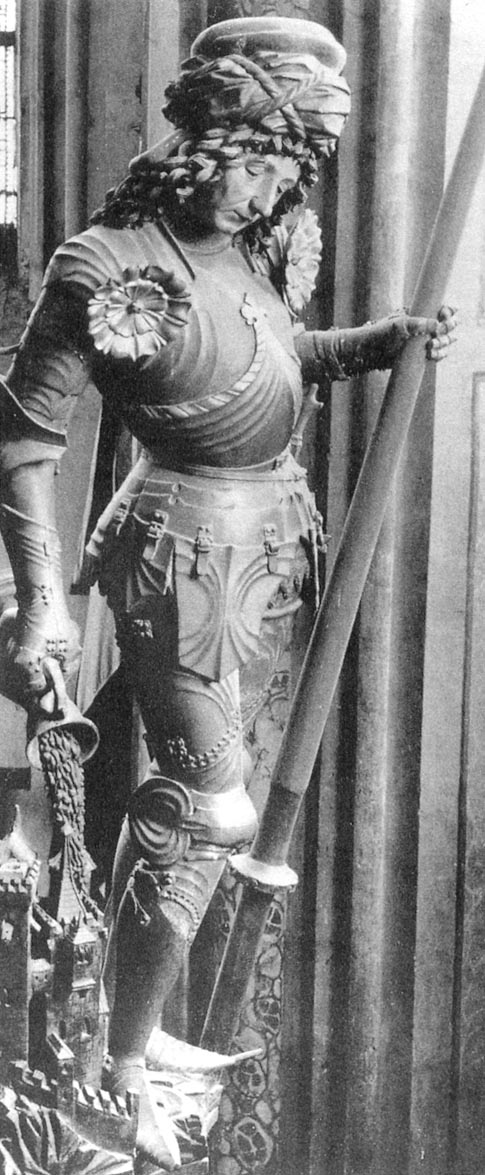
The German armour is quite a bit different in its origins because it's being taken from a wooden sculpture rather than an existing harness. We're copying the harness worn by St. Florian in a statue which is part of an altarpiece in St. Wolfgang's Church in Pfarrkirche, Germany. It was carved by the famous artist Michael Pacher circa 1480. Why these two armours? So once the client decides on the style, where do you start building the armour? What's the process?
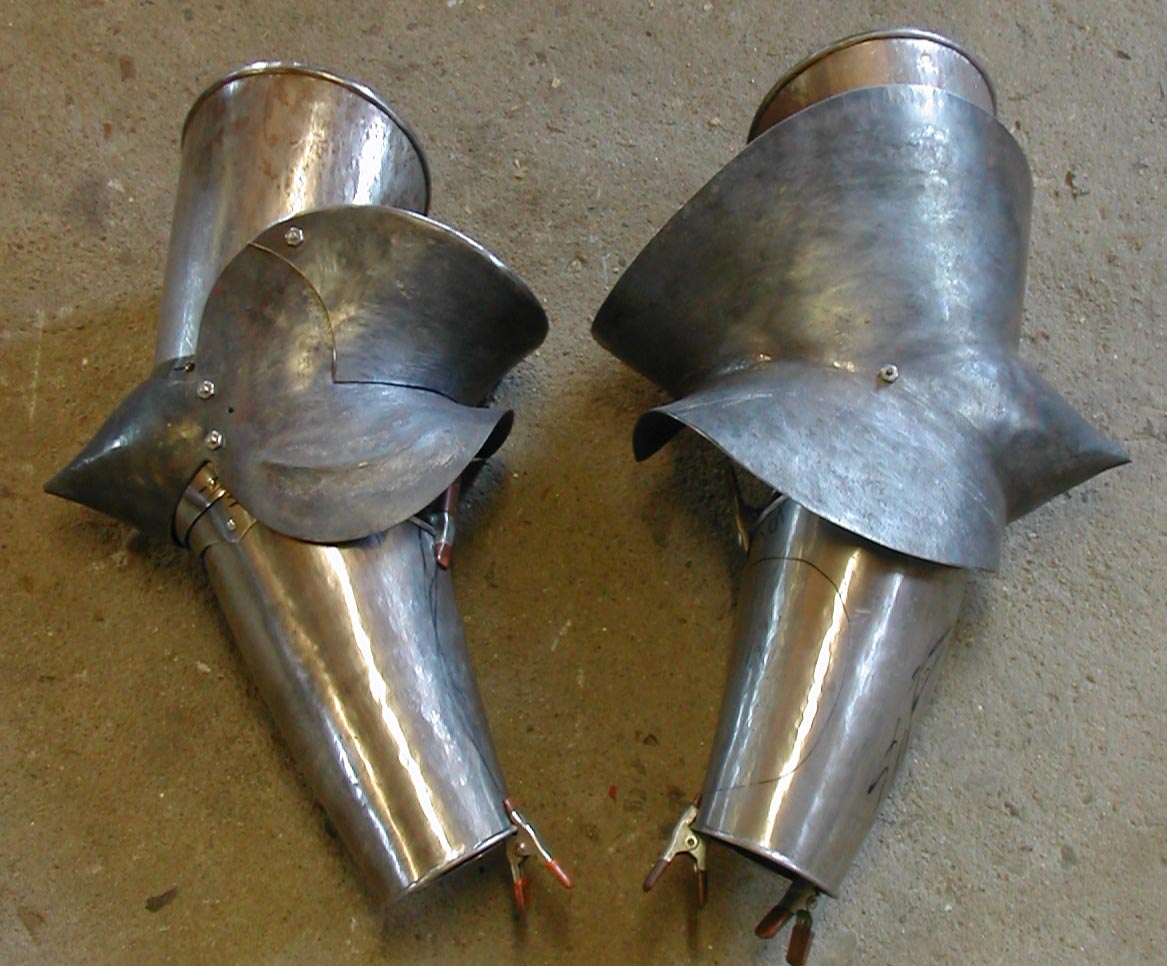
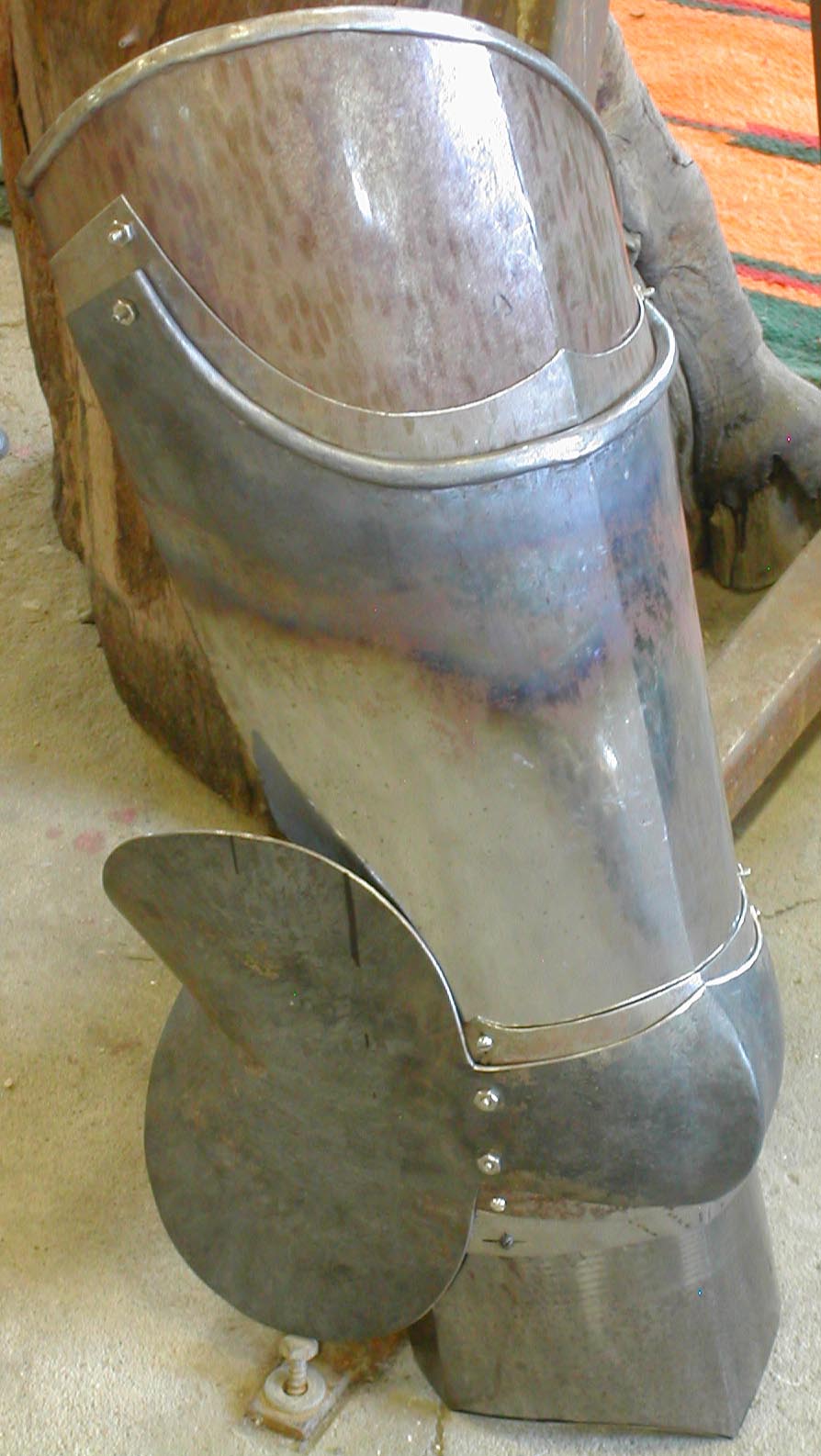
The process began with a visit to my shop by the interpreters who will wear and use the armours. Head of Interpretation Barrett Cooper is getting the Milanese armour, and Interpreter Tony Dingman the German. They flew out, and we spent two days getting the information needed to build the armour-- pages of measurements, dozens of photos, tracings and plaster leg casts for the greaves. We decided to start with the Milanese harness for Barrett. Ultimately, he got this suit because his shape compliments the shape of the armour better, and Tony's measurements worked better for the German. Once I had all this information, the next step is to turn all the measurements into flat patterns for the plates, starting with the cuirass, then moving on to the cuisses and vambraces. Once I had patterns for the plates, the patterns are traced onto the steel. The whole harness is made of 1050 spring steel, but each plate is made of a different thicknesses ranging from .035" to .062" in. At this time I also cut a plate for the skull of the helmet from .083", also in 1050 spring steel, and plates for the greaves.
When the plates were all cut, I started raising the helmet bowl and rough forming the cuirass and limbs. The timing of production worked out so I would be demoing armouring in Leeds in April, so I brought the limb pieces with me to form and fit while I was there. ("Heavy Metal" - Journal Issue No. 3 - June 2005) Not long after my return, Barrett flew out for a fitting. Over the course of two days I fitted the plates, made adjustments and took pictures. I got his harness to the point where I was happy with fit and I could proceed with pauldrons, gauntlets, fauld and tassets, etc. Since then I've been making the rest of the pieces and forming. Forming is probably the single biggest part of the job, but I'm nearing the end of it now.
Do you have a preference for either style or
are they both equally attractive to you?
German armour has a lot of design details like fluting, piercework and cusped edges which break up the surfaces. If there is an imperfection in the shape of the plate these details tend to draw your eye away from flaws. That's not to say German armour is easier, because fluting isn't easy, nor are rolled edges. German armours are usually made up of more plates. One of the challenges is to get all of the plates to fit cleanly and move against each other smoothly. More plates means that each plate occupies a smaller space, therefore there are more of them. Generally, it's more difficult to work on smaller plates that have to fit together rather than fewer larger plates. Overall, I find German armour to be more "fiddly". It's sculptural in a completely different way than Italian. Each style is beautiful in its own way, and presents its own set of challenges.
How close to completion are you?
When you're working from a sculpture, you have to keep in mind that the sculpture is not necessarily carved with reality in mind and the artist may have taken liberties with the design. An artist may never have worn or studied armour, and he or she may not really understand how armour is supposed to work. I have to know what has been accurately represented and what hasn't. That's where knowledge of real armour comes in. Even if I'm able to get great photos and measurements, the fact is that sculpture is an artistic interpretation of armour, not a functioning object like an extant piece. A real piece fit a real person at one time, whereas sculpture has to serve the function of art. In either case, sometimes you can run into a client who has has a completely different body shape than the style or fashionable ideal of the armour they've chosen. When that happens, the armour you make can be mechanically brilliant and work flawlessly but still have a less than pleasing shape. It's pretty difficult to be happy with things in that situation. On the other hand, when you get a client who's body shape is perfect for the armour style they've chosen, and the resulting armour looks just like the piece you're copying, it's fantastic,. When that happens it's just like winning the lottery both from an engineering point of view as well as an artistic view. What does a suit of armour like this cost?
What will you think about this project when it's
all over and done with?
|
The Holidays of Autumn
The period between mid September and the beginning of November mark some of the great feast days of the medieval calendar. September 29 is Michaelmas, followed by the feast of All Saints (1 November:) and All Souls (2 November). All Saints day is prefaced by the unofficial celebration of All Hallows Eve (Hallowe'en/October 31),
Michaelmas is one of the 4 "Quarter Days" in the Church, days which fall around the Equinoxes or Solstices of the old Roman and pre-Christian calendar. Quarter Days mark the beginnings of new natural seasons of Spring (Lady Day (the Feast of the Annunciation) on March 25), Summer (the Feast of St. John on June 24), Fall (Michaelmas, September 29) and Winter (Christmas on December 25) . In medieval times Quarter Days marked units of time for legal purposes, such as settling debts. The agricultural year, consisting of 4 unequal sections, began and ended at Michaelmas, by which time the last of the harvest should have been in. Cold season crops such as wheat and rye were sown from Michaelmas to Christmas. Michaelmas marked the start of the fiscal year for tradesmen.
According to the pre-Christian calendar, the day before Samhain is the last day of summer (or the old year) and the day after Samhain is the first day of winter (or of the new year). Being "between" seasons or years, Samhain was considered a very magical time, when the dead walked among the living and the veils between past, present and future were lifted in prophecy and divination. The dead were honoured and feasted, not as the dead, but as the living spirits of loved ones. The Catholic holidays of All Saints and All Souls Day segued nicely into the existing traditions, as these days are also specifically concerned with honouring the dead. The Vigil of All Hallows (Hallowe'en) became a day of remembering the dead who are neither in Purgatory or Heaven, but are damned to the fires of Hell. Many rituals became attached to Hallowtide, when the Church celebrated with masses for the dead. Torchlight processions and vigils were held, bonfires were lit and churchbells were rung at midnight to comfort the lost souls. In some parts of Europe, the dead were believed to leave Purgatory around the time of All Souls Day and revisit their homes to seek the prayers of their families. Ecclesiastical celebrations could be complimented by secular activities such as great feasting, travel or guising (mumming). Guising, the practice of wearing fancy dress or disguise, and "mumming", involving costumed parading, singing and dancing, had been part of May Day, Christmas and New Years Eve customs in Britain and other parts of Europe since medieval times. An important AllHallow's Tournament occurs near the end of Sir Thomas Mallory's fifteenth century prose romance Le Morte D'Arthur.  By the fourteenth century a custom called 'souling' had developed in England in which the poor would go from house to house asking for soul-cakes, calling
or Soul, soul, an apple or two, The better-off would give out small cakes or loaves in exchange for prayers for their dead relatives. Shakespeare uses the phrase 'to speak pulling like a beggar at Hallowmass'. Souling continued up until the twentieth century in some parts of Britain, though the ritual became increasingly secularized and was eventually relegated to children. Souling almost certainly forms the basis for American 'Trick or Treating'. During the mid sixteenth century the Protestant Reformation put a stop to All Souls Day rituals in England --or at least drove them underground. The Protestants denied the Catholic belief in purgatory and the idea that living humans could help dead souls get to heaven through their deeds. Thus, any Hallowmass activity connected to these beliefs, such as the ringing of church bells at midnight, was forbidden. But such edicts could not stop people from being genuinely concerned for the fate of their dead friends and relatives. All Hallows Eve rituals, which were once centred around the Church, became private family or community rituals. In eighteenth century Derbyshire people made bonfires on the common to 'light the souls out of Purgatory'. In nineteenth century Lancashire Catholic families still assembled at midnight on hilltops to say prayers for the dead. Legends about witches meeting at midnight on Halloween most likely have their roots in sightings by Protestants of Catholics engaging in forbidden Christian religious practices.  The ubiquitous Halloween Jack-o-Lantern is an Irish tradition which may or may not extend back to the Middle Ages. The term 'Jack of the Lantern' first appeared in print in 1750 and referred to a night watchman or a man carrying a lantern. Previous to print, it was used to describe a strange light flickering over the marshes of Ireland. If approached, the light advanced and was always out of reach. The mysterious occurrence is also known as will o' the wisp and ignis fatuus, Gaelic for foolish fire. However, its legendary status reaches far back into Irish folklore with a story of a stingy drunkard named Jack. As the story goes, Stingy Jack was a miserable old drunk who liked to play tricks on everyone: family, friends, his mother and even the Devil himself. Jack had the misfortune to run into the Devil in a pub, some say on Halloween night. Jack had too much to drink and was about to fall into the Devil's hands, but managed to trick the Devil by offering his soul in exchange for one last drink. The Devil turned himself into a sixpence to pay the bartender, but Jack quickly pocketed him in his purse. Because Jack had a silver cross in his purse, the Devil could not change himself back. Jack would not let the Devil go until he promised not to claim his soul for ten years. The Devil agreed and ten years later Jack came across the Devil while walking on a country road. The Devil wanted to collect, but Jack, thinking quickly, said "I'll go, but before I go, will you get me an apple from that tree?" The Devil, thinking he had nothing to lose, jumped on Jack's shoulders to obtain the apple. Jack pulled out his knife and carved a cross in the trunk of the tree. This left the Devil in the air, unable to obtain Jack or his soul. Jack made him promise to never again ask for his soul. Seeing no way out, the Devil agreed. No one knows how the Devil ever managed to get back down! When Jack finally died years later, he was not admitted to Heaven, because of his life of drinking , parsimony and deceit. When he applied for entrance to Hell, the Devil turned him away because he agreed never to take Jack's soul. "But where can I go?", asked Jack. "Back where you came from!", replied the Devil. The way back was windy and dark. Jack pleaded with the Devil to at least provide him a light to find his way. The Devil, as a final gesture, threw a live coal at Jack straight from the fire of Hell. To light his way and to keep it from blowing out in the wind, Jack put it in a turnip he was eating. Ever since, Jack has been doomed to wander in darkness with his lantern until "Judgment Day." Jack of the lantern (Jack o' Lantern) became known as the symbol of a damned soul. The fear of souls like Jack's venturing back to the warmth of their previous homes on Halloween spawned a custom that is carried on today. Originally, Irish villagers, concerned about the possibility of visits from past occupants, would dress in costume to frighten away ghosts. They also left food outside the door to appease the spirits and carved or painted faces on turnips, potatoes, rutabagas, or beets to place in windows or doors in order to chase away ghosts with the symbol of a damned soul. Did you know? La Cuisine Médiévale This month's recipe features the humble turnip, in honour of Jack's "Turnip-o-lantern". The turnip is common root vegetable, sometimes used in medieval recipes as a substitute for pears; the greens were also very popular for salads and in pottages. It is a relative of the radish native to the eastern Mediterranean. Turnips have been under cultivation for about 4,000 years in Eurasia and like the parsnip was a very important staple food before the introduction of the potato. Vegetables such as the turnip were eaten daily in the Middle Ages and Renaissance, but were in many ways considered an inferior to meat dishes, to the point that vegetable dishes are hardly ever mentioned in Medieval cookbooks. Farm and market records, pantry inventories and gardening books all point to considerable vegetable consumption, and it can be deduced that vegetables were an important food item in the diet of nearly all Medieval people. For example, Le Menagier de Paris (a 14th century home manual written by an elderly bridegroom for his young wife) mentions many different flowers, vegetables, herbs, and fruits that are to be contained within their domestic garden. The list of vegetables features beet, leek, cabbage, parsley, bean, pea, spinach, lettuce, pumpkin, turnip, radish, & parsnip. The simplicity and fundamental nature of vegetable preparation often meant that precious vellum or parchment wasn't wasted on recording the recipes; some cookbooks go so far as to point out that the ability to prepare vegetables is common knowledge and further instructions are not necessary. Turnips were added to or formed the basis for pottages, compotes and pickled dishes. A recipe in The 14th century French cookbook Le Viandier de Taillevant gives further credence to the idea that vegetables were common fare: "154. D'autres menuz potaiges...: Other Lesser Pottages, such as stewed chard, cabbage, turnip greens, leeks, veal in Yellow Sauce, and plain shallot pottage, peas, frenched beans, mashed beans, sieved beans or beans in their shell, pork offal, brewet of pork tripe -- women are experts with these and anyone knows how to do them." The following recipe comes from the 15th C. Cookbook by Platina called "De Honesta Voluptatae et Valetudine", or "On Right Pleasure and Good Health". A sinfully rich dish of turnips and melted cheese, Armoured Turnips would as welcome at the family Thanksgiving feast as at a medieval feast. Armoured Turnips Cut up turnips that have been either boiled or cooked in the ashes. Likewise do the same with rich cheese, not too ripe. These should be smaller morsels than the turnips, though. In a pan greased with butter or liquamen, make a layer of cheese first, then a layer of turnips, and so on, all the while pouring in spice and some butter from time to time. This dish is quickly cooked and should be eaten quickly, too. 1 lb parboiled turnips peeled and either
sliced or cubed. Preheat oven to 350*. Butter a baking pan. Place turnips
in a slightly overlapping layer in the bottom of the pan, cover with a
layer of cheese, dot with butter, and sprinkle lightly with pouder douce.
Repeat until you run out of ingredients, but end with cheese. Dot with
butter. Place pan in an oven until brown and bubbly and serve while very
hot. Serves 4-6. October Cut bushes to hedge, fence meadow and redge. Tusser, Thomas. Five hundreth pointes of good husbandrie London, 1586. 
|
||||||||||||
All contents ©2005 by Gwen Nowrick & Historic Enterprises, all rights reserved. Page created by Jenn Reed. |
|||||||||||||


 During
the Middle Ages Michaelmas (pronounced "MICKel-mus.") or the
Feast of Sts. Michael, Gabriel and Raphael was a great religious feast
day. Many popular traditions grew up around the day, which coincided with
the harvest in much of western Europe. Before and after the arrival of
Christianity, early November was when people in Western and Northern Europe
finished the last of their harvesting and butchered any stock which would
not be over wintered. November became known as the "blood month"
when meat was smoked, salted and cured for consumption during the long
winter ahead. Great feasts were held during this time to celebrate the
harvest. In England it was the custom to eat a goose on Michaelmas, which
was supposed to protect against financial need for the next year. In Ireland,
finding a ring hidden in a Michaelmas pie meant that one would soon be
married. According to an old Irish folk tale, blackberries were supposed
to have been harvested and used up by this date. Superstition told that
when Satan was kicked out of Heaven, he landed in a bramble patch -- and
returns each year to curse and spit on the fruits of the plant he landed
on, rendering them inedible thereafter.
During
the Middle Ages Michaelmas (pronounced "MICKel-mus.") or the
Feast of Sts. Michael, Gabriel and Raphael was a great religious feast
day. Many popular traditions grew up around the day, which coincided with
the harvest in much of western Europe. Before and after the arrival of
Christianity, early November was when people in Western and Northern Europe
finished the last of their harvesting and butchered any stock which would
not be over wintered. November became known as the "blood month"
when meat was smoked, salted and cured for consumption during the long
winter ahead. Great feasts were held during this time to celebrate the
harvest. In England it was the custom to eat a goose on Michaelmas, which
was supposed to protect against financial need for the next year. In Ireland,
finding a ring hidden in a Michaelmas pie meant that one would soon be
married. According to an old Irish folk tale, blackberries were supposed
to have been harvested and used up by this date. Superstition told that
when Satan was kicked out of Heaven, he landed in a bramble patch -- and
returns each year to curse and spit on the fruits of the plant he landed
on, rendering them inedible thereafter.  The
next Church holiday is Hallowmas (short for Middle English Alholowmesse,
from Old English ealra halgena mæsse, literally, all saints' mass)
which follows on November 1 and All Souls on November 2. These feast days
fall in the same time interval as the Celtic (or at least Irish) holy
days of Samhain. This is not necessarily unusual, as many pre-Christian
holidays were adapted in the early years of the Church.
The
next Church holiday is Hallowmas (short for Middle English Alholowmesse,
from Old English ealra halgena mæsse, literally, all saints' mass)
which follows on November 1 and All Souls on November 2. These feast days
fall in the same time interval as the Celtic (or at least Irish) holy
days of Samhain. This is not necessarily unusual, as many pre-Christian
holidays were adapted in the early years of the Church.