|
|
Journal Issue No. 6 - February 2006 |
|
|
Historic Enterprises Announces Sponsorship In the Spring of 2006, Historic Enterprises and Black Swan Designs entered into a cooperative partnership with UK jouster and historical horseman Dominic Sewell. Black Swan Designs owner Gwen Nowrick explains how the idea came about. "We've been friends with Dominic for for a number of years and knew him to be an amazing guy with a fantastic attitude. We were very impressed by his overwhelming desire to present a historically accurate impression and drive to be the best at what he does. Dom began as an enthusiastic client of HE/BSD, and the longer he wore our kit he quite unintentionally became one of our most vocal advocates. Teaming up with him in a sponsorship simply formalizes an informal relationship that already exists."
"I was impressed by Jeff and Gwen's range of knowledge and attention to detail from the first time I met them at the Royal Armouries in Leeds some years ago" explains Dominic "At that time I only knew them as reenactors interested in jousting. A friendship quickly grew out of our passion for both the sport and a high quality presentation. From the moment I wore my first pair of Gwen's hose and saw how well they fit and functioned, I knew they were on to something and wanted to help them reach more reenactors." Getting the word out Dominic continues "This sponsorship is self serving in that it furthers my efforts to present a very high quality impression. A few years ago I was unlucky enough to have a vehicle with all of my kit in it stolen, and I lost everything. Until recently, I'd only just managed to replace some of this kit at huge cost. However, since my partnership with HE I'm now able to concentrate on horses and other equipment while HE and BSD supply me with clothing and kit I could only dream of owning." An invaluable resource
Dominic laughs wryly and continues- "I'm very interested in modern fashion, and that translates to an avid interest in medieval fashion- how clothes fit, what they say about the wearer, why colours work or don't work, that sort of thing. All of that is reflected in what kit that I've chosen to wear. I guess you could say I'm a bit of a peacock; I always have to have the tightest hose, the shortest doublets, the pointiest shoes. This is what I see in period texts and I am absolutely passionate about looking like the period images I study. This high quality is vital if I am to give a convincing impression of a mounted man at arms. I consider myself extremely fortunate to have the support of Historic Enterprises to further my goals in creating that flawless historical impression". "Dominic is a tailor's dream" Gwen interjects, "Not only is he physically built like the people we see in the period art, when he puts his kit on he carries himself completely differently than he does everyday. While in kit he just assumes an aura of class and grace that makes him look just like he stepped out of a manuscript. I have to admit it really is thrilling to see him in our kit!" In the public eye You can see photos of Dominic in action and follow him this year on his blog at http://jousterdom.blogspot.com/ A Knight's Tale Historic Enterprises/Black Swan Designs unveils a new direction for 2006 by announcing a sponsoring partnership with one of the UK's premier jousters and historical equestrians, Dominic Sewell. In this interview, Dominic talks about reenactment, interpretation and why bringing history to life is such a passionate pursuit.
How did you get started? What was the Astly connection? How do you view what you do- is it living history,
theatre, or what? Sociology? What sort of historical scenario or person do
you portray in these pieces? The public, especially children, see you as "A
Knight". What does "being a knight" mean to you? I think most people think of a knight as a solo act- the guy on the horse in armour and all that. I don't think people realize nothing could be further from the truth! A knight leads, but he needs the support of his followers to be where he is- it's a completely supportive relationship, and one can't exist without the other. So being a knight is being in command, and being responsible for those under your command. Why are you a historical horseman, and not just
a footsoldier where you started? One of the most vivid experiences of my childhood was seeing a reenactment at Barnard Castle when I was 8. As impressed as I was by the battle, nothing about the day stands out as clearly in my mind as the group of costumed riders at the event. Their image stayed with me and came back in full force 20 years later when I saw a friend charge onto a reenactment battlefield, horseback and clad in armour. I had no idea he could ride but instantly decided if he could ride then so could I, and the next week I joined the group which was ultimately to become Destrier and began taking riding lessons. From that point on, my involvement with historical recreation, reenactment, interpretation, whatever you want to call it, became focused on the horse's role in history, and the rider's relationship with the horse. What are your feelings and thoughts about jousting-
what drew you to it, is it important to you, is it just a sport? For me, jousting is not just jumping on a horse and riding off with a lance in my hand to be the hero. I have to prepare both myself and my horse mentally and physically for what we're about to do. Like any athletic team, we have to train regularly to keep on top of our game. I have to maintain my armour, tack and other kit. Jousting is a mirror on myself- I have to be balanced, focused and ready to undertake what amounts to single combat in a sport that could kill me if I'm not. Jousting is something I think about every day in one way or another, because like any martial art, it requires a mental discipline that can be applied to everyday life. Is there anything you're passionate about? If
so, what is it? I've studied and learned a tremendous amount from the natural horsemanship people in the US, people like Monty Roberts and John Lyons. Although their techniques work brilliantly, much of their philosophy is considered rubbish in the mainstream UK horse world, which is pretty much mired in the traditions of the BHS (British Horse Society) school. In some ways I'm considered a quack because I use and believe in these "natural horsemanship" techniques, but I do the best I can, always trying to do right by the horses. There is no jousting, hunting, or cavalry activities without the horses, so I guess I'm most passionate about that aspect of what I do. Has participation in Living History changed you
in any way? If so, how? Does your hobby overlap your "real" life in any
way? A knight has to have a horse, so tell us about
yours
My second horse is Cobrador, a 7 year old Pure Registered Espanola (Andalusian) who I will be using as a knight's palfrey for hunting games and skill at arms. In addition, I will be introducing my first reserve , Oliver (AKA Ambrosius), who is a jolly little 14.3 Gypsy Vanner/cob cross. Oliver has proven to be the most willing horse I've ever trained, and looks to be an up and coming star in the field of historical equestrian activities. |
A Knight's Tale (continued) What's your schedule like for 2006? In addition, I will be jousting in 2 competitions at the Royal Armouries in Leeds with the cream of the world's jousters. In my view this is the world championship, the world's premier jousting event. I'm proud to be a part of it, where I get to joust against my friends, who are my peers and my heroes. In October I will command a wing of the Norman cavalry as English Heritage repeats their 2000 reenactment of the Battle of Hastings. Over 100 horses will be on the battlefield at the same time with thousands of footsoldiers from all over the world. This is an amazing sight only a few thousand people will ever see in their lifetime. Truly awe inspiring.
In addition to my commitment to English Heritage, I am the Chairman of Destrier, known as the premier historical equestrian group in the UK. I will be participating in jousts and skill at arms shows throughout the UK thru the summer with the group. The History Valentine's Day Roman Roots
A Trio of Valentines Most scholars believe that the St. Valentine of the holiday was a priest who attracted the disfavor of Roman emperor Claudius II . According to one legend, Claudius II had prohibited marriage for young men, claiming that bachelors made better soldiers. Valentine continued to secretly perform marriage ceremonies but was eventually apprehended by the Romans and put to death. Another legend has it that Valentine, imprisoned by Claudius, fell in love with the daughter of his jailer. Before he was executed , he allegedly sent her a letter signed "from your Valentine", a phrase which is still used prominently on today's cards.
Chaucer's Love Birds Medieval Europeans believed that birds began to mate on Feb. 14. In 1381, Chaucer composed a poem in honor of the engagement between England's Richard II and Anne of Bohemia. As was the poetic tradition, Chaucer associated the occasion with a feast day. In "The Parliament of Fowls," the royal engagement, the mating season of birds, and St. Valentine's Day are linked: For this was on St. Valentine's Day,  Holiday traditions
Good morning to you, valentine; In Wales, wooden love spoons, carved with key, keyhole and heart designs, were given as gifts. The gift of flowers on Valentine's Day probably dates to the early 1700s when Charles II of Sweden brought the Persian poetical art called "the Language of Flowers" to Europe. The rose, representing love, is probably the only flower with a meaning that is universally understood. The red rose remains the most popular flower bought by men for their sweethearts. Verbal and singing valentines began to be replaced by written missives in Europe in the 15th century. The first written valentine is usually attributed to the imprisoned Charles, Duke of Orleans, in 1415. He reportedly passed the time by writing romantic verses for his wife. By the 16th century, written valentines were commonplace.
X - the kiss Although Pope Paul VI dropped St. Valentine's Day from the church calendar 1969, the secular holiday is so entrenched that Valentine's Day is here to stay! La Cuisine Médiévale Meat pies of every variety were a staple of medieval Europe in the Middle Ages. They, along with pastries, bread, and ale were included in the supplies which were readily available for purchase from specialty suppliers. In Chaucer’s Reeve’s Tale, when unexpected company arrives at the mill, the miller sends his daughter out shopping: This miller inot toun his doghter sende Almost all houses had a fire and spit with which to roast meats, but most had no oven in which to bake. The baker therefore not only baked bread, but also cooked pies. The accounts of two chantry priests at Bridport, Dorset in January 1455 list food purchased for a dinner party, including "a payment of 5 pence to William the Baker for flour, his labor, and the Œpies made'". The contents of ready made pies was sometimes suspect. The cooks of many large households sold their kitchen waste to bakers, who turned it into pies. Apparently this practice became so widespread that in 1379 an ordinance was passed: "Because that the Pastelers [pastry cooks] of the City of London have heretofore baked in pasties rabbits, geese, and garbage, not befitting, and sometimes stinking...it is ordered that...no one of the said trade shall buy...at the hostels of the great lords, of the cooks of such lords, and garbage from capons, hens or geese, to bake in a pasty, and sell." "Garbage" in this context refers to animal entrails, which it seems was not the meat of choice for the making of pies. The following recipes are made with more mainstream (and appealing!) ingredients. MYLOT OF PORK "Hewe Pork al to Pecys and medle it w ayren @ chese igted, do thto fort fafron @ pyuner with falt, make a cruft i a trap, bake it wel thinne, and sue it forth." - Forme of Cury, xx. VII.XV, pg.70 l lb. country sausage Mix together all ingredients. *Roll pastry crust or biscuit out on a very well floured surface to about 3"-4" in diameter. Use an ice-cream scoop to portion and make filling pasties easier. Place 1 scoop on the flattened pastry or biscuit. Use a pastry brush to wet edges dough with water. Roll another bit of pastry or biscuit, and position over the filling. Seal edges well by poking almost all the way through the edge surrounding the filling. Place pies on a cookie sheet. Bake at 350* for 20-25 min. until biscuits are nicely browned. CHICKEN PASTIES LOMBARD Chicken may be set in a pastry on their backs with the breast upward and large slices of bacon on the breast, and then covered. Item: In the Lombard manner, when the chickens are plucked and prepared, take beaten eggs, both the yolks and the whites, with verjuice and spice powder, and dip your chickens in this; and set them in the pasty with strips of bacon, as above." -Le Menagier de Paris Boneless, skinless chicken breasts and/or thighs Cut the chicken meat into 1" cubes and pound to 1/2 " thickness. Beat egg together with vinegar and spices. Dip the chicken chunks into the egg mixture and wrap with a half slice of bacon. Follow filling and baking directions from * above. Armyng Poyntes Some time ago my curiosity was piqued by a discussion of coloured points on the Firestryker forum. The final agreement in that discussion was that few examples of coloured points existed in the visual record, and that the written references were ambiguous at best. A discussion of coloured points with a museum curator friend resulted in him sending me a very clear image from The Trinity Altarpiece (Hugo van der Goes, 1478), where coloured points are clearly seen on St. George's couter.
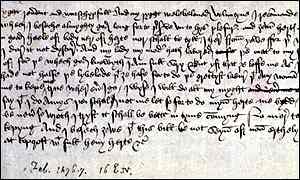
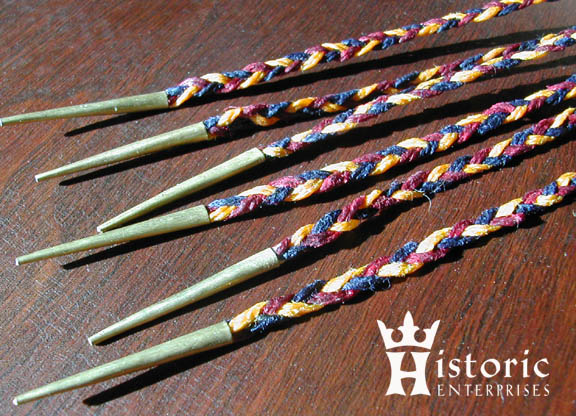
What's exciting about the painting is that not only are the points three coloured, the lace itself is clearly made up of a rather ordinary three-plait braid, rather than a fingerwoven braid. The simplicity of it intrigued me, so I had to have a go at it. I refered to the Hastings manuscript when choosing the point material and finishing details: the armynge poyntis muste be made of fyne twyne suche as men make stryngis for crossbowes and they muste be trussid small and poyntid as poyntis. Also they muste be wexid with cordeweneris coode. And than they woll neythirrecche nor breke. When consulted, several bowyers said the best crossbow strings were made with hemp cord, so I used 6 strands of hemp cord (2 each of 3 colours) for the braid itself, which was a made in a simple 3-plait braid. The manuscript says they must be "poyntid as poyntis" which I took to mean they should have metal chapes attached to the ends. This practice is well documented in written records of the period, as well as the chapes being a common archaeological find. Metal chapes are also seen in the Trinity Altarpiece, so I affixed our Lace Chapes to the ends with Gorilla Glue. Note- Authenticity mavins could substitute hide glue for the Gorilla Glue, or drill and rivet or drill and stitch the chapes on. Since the glue doesn't show, I don't much care that it's modern. I actually made two sets, one for my friend Dominic and one for Jeff. Jeff's (pictured) are red, blue and gold; Dominic's are red, gold and black. Per the manuscript direction, both sets have been saturated in beeswax to improve wear and grip on the armour. I found that a small project like this is fast and easy to do, and doesn't require any fancy tools or setup. It's clean, quiet, and very portable. It's the sort of thing one could easily work on at an event while chatting with friends. It's inexpensive, too- this dozen 20" laces cost about $20 in materials and took about 3 hours start to finish. It's the sort of finishing touch that can really add flair to your kit and bring it to the next level, so the next time you're looking for a quick, clean project, consider making a set of points!
|
||||||||||||||||||||
All contents ©2006 by Gwen Nowrick & Historic Enterprises, all rights reserved. Page created by Jenn Reed. |
|||||||||||||||||||||